
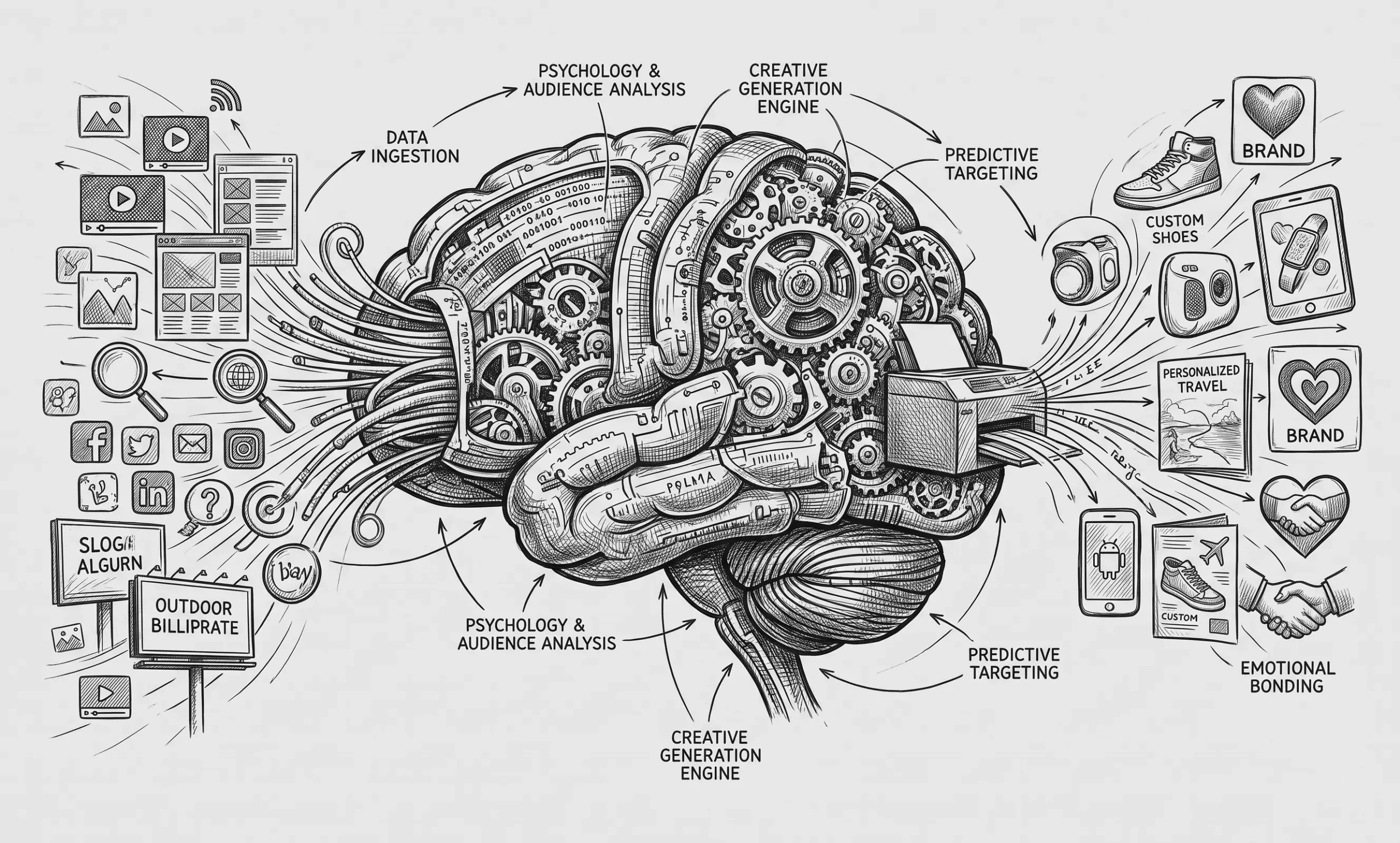
Advertising in the Age of AI
Advertising - the way to draw attention and capture the mind of the people
Advertising is the practice and techniques employed to bring attention to an idea, product or service. Advertising aims to present a product or service in terms of utility, advantages, and qualities of interest to consumers. It is typically used to promote a specific goods or service, but there are a wide range of uses, a common form being commercial advertisement.
Advertising is form of marketing communication that aims to persuade and influence people to take a specific action, like buying a product or using a service.
Over the years it used to be a creative exercise relying on human observation and understanding of public behaviour and interest. It used to be a team job with special expertise in psychology, statistics, design and product knowledge.
How does Advertising function?
Advertising helps sustain brands. It’s focused on getting a message out to a specific customer type or audience to get them to take a specific action. Types of advertising include video, display, paid search, paid social, print, email, radio, TV, and outdoor.
Advertising helps brands inform, persuade, and influence a target audience to take a specific, valuable action. Today, advertising is fundamentally about creating a value exchange with the consumer. The global advertising market’s projected size is $1.3 trillion, highlighting the immense investment and reliance on sophisticated advertising strategies.
Creating an effective advertisement involves defining a clear objective, identifying the target audience, and crafting a compelling message with a strong call-to-action (CTA). Key elements include a scroll-stopping hook, high-quality visuals, a concise, benefits-driven headline, and placing the product or brand prominently within the first two seconds.
This modern practice is built upon four crucial pillars:
Building Brand Awareness: Advertising serves to make a brand visible and memorable. The goal is to ensure a brand is instinctively recalled by consumers when a relevant need comes up. This involves a consistent and strategic presence across various media channels.
Targeted Messaging: Advertisers can now deliver hyper-relevant messages to specific audience segments with precision. Leveraging large datasets that collect demographics, interests, and online behaviors, advertising ensures that communications reach the most receptive individuals at the right time.
Driving Action: Advertising campaigns are designed to elicit a specific, measurable response from the audience. This desired action can range from top-of-funnel engagement — such as clicking an ad or signing up for a newsletter — to bottom-of-funnel conversion, such as making a purchase.
Creating Emotional Bonds: Advertising can create an emotional bond with the audience. When consumers connect with a brand on a personal, emotional level, they are more likely to develop long-term loyalty, becoming advocates and repeat customers.
In the past, advertising success was often measured by reach and repetition — how many millions of people saw a television commercial, for instance. Digital platforms introduced interactivity and basic tracking, allowing for the measurement of clicks and website visits. The emphasis on emotional connections and driving action signifies that success is measured by the quality of engagement and its impact on business outcomes. This shift requires advertising to provide tangible value to the consumer — be it information, entertainment, or utility — in exchange for their attention and data.
The Shift to AI Reliance from Human Intelligence
AI is now a regular part of marketing and advertising: more than half of marketers already use GenAI for creative content and audience targeting, while nearly all plan to expand AI use next year, especially for content development and audience engagement. But while adoption is accelerating, safeguards are not. Over 70% of marketers have encountered an AI-related incident in their advertising efforts, including hallucinations, bias, or off-brand content, yet less than 35% plan to increase investment in AI governance or brand integrity oversight over the next 12 months.
As AI becomes central to how brands create content and connect with audiences, the advertising industry is at an inflection point. Marketers are eager to innovate, but without clear governance, they risk brand trust, compliance, and long-term value. Now is the time for coordinated action to prioritize shared standards, stronger tools, and responsible practices to ensure AI enhances – rather than undermines – the future of advertising.
AI is Growing its Usage in Communication & Marketing
AI is now part of the marketing toolkit across the board. Over half of marketers are already using it for creative content, audience targeting, customer support, with nearly as many applying it to predictive analytics.
This usage is set to grow: 58% plan to increase AI for creative generation in the next year, along with expanded use in chatbots, targeting, and forecasting. AI isn’t just a trend, it’s quickly becoming core to how marketing gets done.
The Flip side of Using AI in Marketing
Marketers are well aware that there can be risks with AI-generated advertising. Top concerns include misinformation and deepfakes, loss of creative control, and brand integrity risks from offensive or harmful outputs. Many also worry about consumer trust, with 37% fearing audiences will distrust ads made by AI. Other concerns include bias and fairness, regulatory compliance, and the challenge of monitoring AI content at scale. Some flagged the threat of adversarial prompts, like jailbreaks that trick models into unsafe behavior.
The implication is rather obvious. AI can pose serious ethical and quality risks, and marketers know these issues can damage trust and brand reputation. That’s why over 60% support labeling AI-generated ads, with only 15% opposed—signaling a strong push for transparency as a trust safeguard.
Industry Calls for Standards, Tools, and Transparency
Marketers are calling for stronger AI governance. When asked what’s needed to keep AI in advertising safe and effective, top priorities included regular AI audits for bias and integrity, transparency in AI decision-making, data privacy protections, and IP safeguards for AI-created content.
In short, marketers want tools, policies, and standards to close real governance gaps. Only 6% believe current safeguards are enough. This is an opportunity for the industry to define systems, tooling, and benchmarks that can ensure AI outputs are safe, accurate, and aligned with brand values.
Accountability and Leadership: Who’s Driving the AI?
One major challenge in AI governance is ownership. When asked who leads these efforts, responses vary, with the majority mentioning executive leadership or a dedicated AI task force, marketing/creative team’s, or legal/compliance teams are taking the lead. Some also rely on data science or MarTech teams. Only 17% of organizations currently use an external partner for AI governance today, suggesting most are building internal capabilities. But not all have definitive accountability:14% say no one owns AI governance, and others aren’t sure who does.
Without structured ownership, risks can fall through the cracks. As companies scale GenAI, it’s critical to define who is responsible, whether it is a chief AI officer, cross-functional council, or dedicated team. This clarity is essential to move from good intentions to accessible solutions that enable oversight, testing, and enforcement, regardless of organizational structure. Once roles are defined, organizations need to ensure their third-party partners are aware of who is responsible in order to enable better collaboration, strengthen industry relationships, and help mitigate shared risks.
Third-Party Support for Governance
While most companies currently manage AI governance in-house, there’s strong interest in external support. When asked if they’d consider a third-party solution to evaluate risks like hallucinations, bias, or off-brand content, over 90% said yes.
Many see outside expertise as a valuable safety net. One marketer said it would offer “peace of mind,” while another noted it would “reduce risk to our brand and business.” Only a few were skeptical, mostly due to confidence in internal teams or concerns about cost. But those views were rare. Marketers are open and eager for expert tools and guidance to ensure their GenAI use is safe, effective, and aligned with brand values. This presents a timely opportunity to partner with trusted third parties to strengthen AI oversight across the industry.
A Call to Action on Responsible AI
We see an industry moving fast on AI – but still building the guardrails as it goes. Advertisers are excited about AI’s potential for content, targeting, and engagement. But many have already seen the risks firsthand: misinformation, bias, and off-brand content that damage trust and waste budget.
Marketers are sending a strong message: they want help in the form of better standards, stronger tools, and expert support to use AI responsibly. Now is the time for collective action. Brands, agencies, publishers, and platforms all have a role to play in shaping AI governance.
Here are four steps to move forward:
Make AI governance a priority. Assign ownership, engage leadership, and establish a cross-functional task force if you don’t have one already. Prioritize not only who is responsible, but how responsibility is translated into day-to-day workflows, review processes, and evaluation methods.
Build your best practices. Start with foundational checks like human review, policy guidelines, bias testing—and build toward structured evaluations, automated audits (with human-in-the-loop oversight where appropriate), and continuous monitoring that can scale with content volume and model complexity.
Bring in expert support to scale. Accelerate safely with trusted experts and third-party tools designed to evaluate, test, and certify AI-driven content at scale, so your team can move faster without increasing risk.
Lead with transparency. Don’t just say you use AI responsibly – prove it. Build systems that track how AI is used, flag risks, and generate audit-ready records. Stay vigilant on fairness, privacy, and ethics. Consumer trust depends on it.
The data is clear: AI is undeniably transforming advertising but incidents are already happening, current safeguards aren’t keeping pace, and marketers need better solutions. This isn’t a future problem to solve but instead a present reality demanding immediate action to unlock AI’s full potential. With a few practical steps, responsible AI is not only possible – it can be the norm.